
What Is BMR? Basal Metabolic Rate, Formula and What Your Number Means
Last Updated: August 2026
Even when you spend most of the day resting, your body still needs energy.Your heart keeps beating. Your lungs keep breathing. Your brain, liver, kidneys, and other organs keep working.
BMR stands for Basal Metabolic Rate. It estimates the energy your body needs to maintain essential functions under specific resting conditions.
Your number can help you understand where your energy needs begin, but it’s one of the most misunderstood numbers in nutrition.
BMR is not the same as maintenance calories, TDEE, or the number of calories you should automatically eat to lose weight.
Most BMR calculators stop at giving you a number. This guide shows you three different formulas side by side, explains exactly why they disagree, and walks through a full worked example by hand ,so you understand where your number comes from, not just what it is.
What Is Basal Metabolic Rate?
BMR is the number of calories your body needs to perform essential functions like breathing, circulation, brain activity, organ function while completely at rest. It does not include movement, digestion, or exercise.
That energy supports functions such as:
What Your BMR Supports
BMR is commonly expressed as kilocalories per day, usually shortened to calories per day.
If your estimated number is 1,500 calories per day, that does not mean you should eat 1,500 calories. It means a formula predicts your body uses roughly that amount for basal functions at rest. Your actual daily energy use is higher once normal life enters the picture.
What Does BMR Mean for Your Daily Calories?
Think of your resting energy needs as the foundation of your daily calorie expenditure, not the whole building. You also use energy walking to your car, working at your desk, shopping for groceries, cleaning the house, digesting a meal, exercising, or climbing stairs.
Basal energy needs + other daily energy expenditure = total daily energy expenditure (TDEE)
This answers the most common question people have after seeing their number: “Is this how many calories I should eat?” Not necessarily. Your basal estimate tells you about resting energy needs — not everything you burn in a normal day.
If your real question is “How many calories do I burn per day?” use our TDEE Calculator to estimate your total daily energy expenditure.
Why Is Knowing Your BMR Useful?
Knowing your estimated resting energy needs gives you context. It helps explain:
Why your body burns calories even at rest
Why calorie needs differ from person to person
How resting energy fits into total daily expenditure
Why body size and composition matter to energy needs
Why maintenance and weight-loss targets shouldn’t come from a random calorie number
Use BMR as a reference point
Treat the result as a reference point, not a diet prescription. It doesn’t tell you by itself how much to eat to maintain, lose, or gain weight.
How Do I Calculate My BMR?
Most people don’t have their metabolic rate measured in a lab. Instead, predictive equations estimate resting energy needs using age, sex, height, and weight.
There’s more than one BMR formula, one reason two calculators can give you different answers.
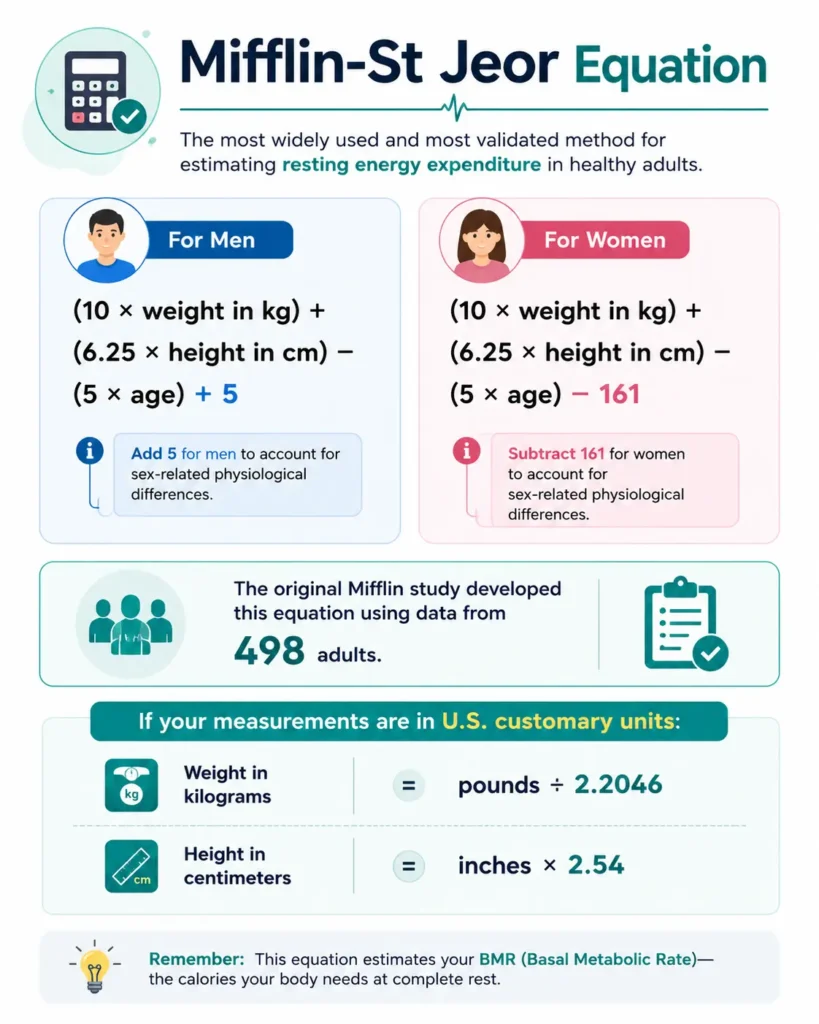
Mifflin-St Jeor Equation
The most widely used and most validated method for estimating resting energy expenditure in healthy adults.
For men: (10 × weight in kg) + (6.25 × height in cm) − (5 × age) + 5
For women: (10 × weight in kg) + (6.25 × height in cm) − (5 × age) − 161
The original Mifflin study developed this equation using data from 498 adults.
If your measurements are in U.S. customary units:
Weight in kilograms = pounds ÷ 2.2046
Height in centimeters = inches × 2.54
Revised Harris-Benedict Equation
One of the earliest predictive approaches, later revised using newer data. Because Mifflin-St Jeor and Revised Harris-Benedict were built from different datasets and statistical models, they don’t always produce identical results.
Katch-McArdle Formula
Use lean body mass as an input rather than total body weight, making body composition central to the calculation.
The catch: you need a reasonably accurate lean-mass estimate. If your body-fat percentage is wrong, that error carries into the result. For someone who doesn’t know their body composition, an equation using readily available measurements is more practical.
BMR Calculation Example
Meet Sarah, a fictional 30-year-old woman who weighs 180 pounds and is 5 feet 5 inches tall.
Convert her measurements
180 pounds ÷ 2.2046 = 81.6 kg
65 inches × 2.54 = 165.1 cm
Apply Mifflin-St Jeor
(10 × 81.6) + (6.25 × 165.1) − (5 × 30) − 161
816 + 1,031.9 − 150 − 161 = approximately 1,537 calories per day
Sarah’s estimated resting energy requirement is about 1,537 calories per day.
Here’s the part people often miss: Sarah doesn’t spend 24 hours lying still. She gets dressed, walks, works, eats, runs errands, and maybe exercises. Those activities require additional energy on top of her BMR.
Activity is not added to calculate BMR itself. It becomes relevant when moving from resting energy needs to total daily energy expenditure.
Why Do Different BMR Formulas Give Different Answers?
BMR equations produce different estimates for the same person because they were built from different study populations, variables, and statistical models. A gap of 50–150 calories between formulas is normal, it doesn’t mean either one is “wrong.”
| Formula | Main Inputs | Why the Result May Differ |
|---|---|---|
| Mifflin-St Jeor | Weight, height, age, sex | Built from a modern study population; considered most accurate for general adult use. |
| Revised Harris-Benedict | Weight, height, age, sex | Uses different coefficients from an older, separately derived dataset. |
| Katch-McArdle | Lean body mass | Result depends heavily on the accuracy of your body-fat estimate. |
If Mifflin-St Jeor estimates 1,537 calories and Harris-Benedict returns a somewhat different number, neither calculator is “broken” both are predictions built on different foundations.
A calculated metabolic rate is an estimate, not a direct measurement of exactly how many calories your body burns.
What Is a Normal BMR?
There is no single “normal BMR” every adult should aim for.
Resting energy needs depend on body size, lean tissue, age, sex-related physiology, genetics, and health. A larger person generally requires more resting energy than a smaller person, simply because there’s more tissue to maintain.
Comparing your number with your spouse, gym partner, or a number from social media usually isn’t useful. A lower result isn’t automatically bad. A higher result isn’t automatically better. The useful question is whether the estimate makes sense for your body and total energy needs.
BMR vs. RMR: What’s the Difference?
BMR is measured under strict, controlled resting conditions. RMR is measured under more relaxed resting conditions and tends to run slightly higher. Both estimate resting energy use, neither represents your full daily calorie burn.
True basal measurement requires carefully controlled conditions: appropriate rest, fasting, and a specific testing environment. Resting metabolic testing is more practical in most clinical settings, which is why RMR shows up more often in real-world testing.
You’ll often see BMR and RMR used interchangeably on fitness websites. For most readers, the distinction that actually matters is this: both describe resting energy use, and neither is your complete daily expenditure.
BMR vs. TDEE: Are They the Same?
No.
BMR estimates energy required for essential functions at rest. TDEE estimates total energy expenditure across your entire day.
BMR
- Focuses on basal energy needs
- Does not represent a normal active day
- Not the same as maintenance calories
- Usually lower than total daily needs
TDEE
- Estimates broader daily energy use
- Accounts for daily activity and movement
- Commonly used to estimate maintenance needs
- Usually higher because normal life requires more energy
Suppose your basal estimate is 1,500 calories. You shouldn’t conclude “I only burn 1,500 calories a day.” Your actual daily expenditure reflects normal movement and activity on top of that baseline.
The relationship in three lines:
- BMR → resting energy
- TDEE → total daily energy
- Calorie target → depends on your goal
Use the TDEE calculator to estimate the broader amount of energy you use during a typical day.
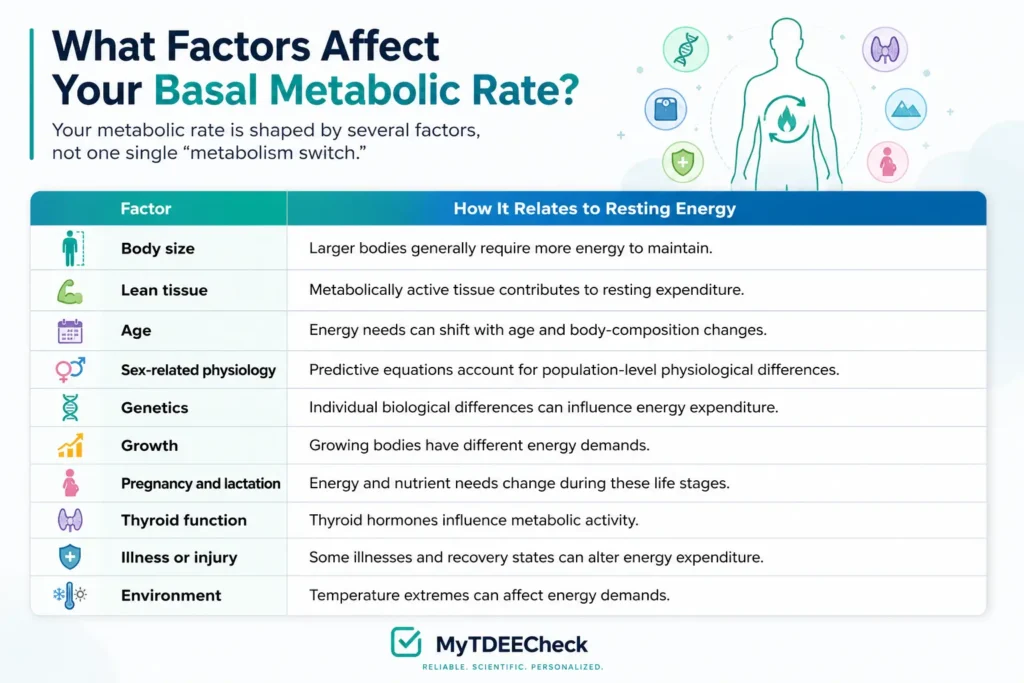
What Factors Affect Your Basal Metabolic Rate?
Your metabolic rate is shaped by several factors, not one single “metabolism switch.”
| Factor | How It Relates to Resting Energy |
|---|---|
| Body size | Larger bodies generally require more energy to maintain. |
| Lean tissue | Metabolically active tissue contributes to resting expenditure. |
| Age | Energy needs can shift with age and body-composition changes. |
| Sex-related physiology | Predictive equations account for population-level physiological differences. |
| Genetics | Individual biological differences can influence energy expenditure. |
| Growth | Growing bodies have different energy demands. |
| Pregnancy and lactation | Energy and nutrient needs change during these life stages. |
| Thyroid function | Thyroid hormones influence metabolic activity. |
| Illness or injury | Some illnesses and recovery states can alter energy expenditure. |
| Environment | Temperature extremes can affect energy demands. |
No simple equation captures every individual difference perfectly, another reason to treat the result as an estimate, not a fixed fact.
Can You Increase Your BMR?
There’s no proven food, drink, supplement, or morning routine that dramatically “resets” your metabolism.
Body size and composition are the biggest influences on resting energy expenditure. Lean tissue requires energy to maintain, so changes in muscle mass can affect resting needs resistance training supports muscle, strength, and overall health. But building muscle doesn’t turn your metabolism into a furnace that burns unlimited calories.
Age, genetics, hormones, and health still matter. Be skeptical of anything promising to “supercharge” or permanently “boost” your metabolism through a quick fix.
Should I Eat My BMR to Lose Weight?
No. Your BMR should not automatically become your weight-loss calorie target. Weight loss depends on the gap between your total daily expenditure (TDEE) and your intake, not your resting number alone.
Suppose your BMR is 1,500 calories. Your total daily expenditure is likely higher, because you walk, work, digest food, exercise, and move throughout the day.
So if you’re asking ,“My BMR is 1,500 should I eat 1,500 calories?” your basal number alone can’t answer that.
Next steps:
Read our Calorie Deficit Guide to understand how intake and deficit relate to weight loss
Is It Bad to Eat Below Your BMR?
Eating below your estimated basal number on one particular day doesn’t mean your organs shut down or your metabolism gets “damaged.” Your body can draw on stored energy when intake dips below expenditure.
But that doesn’t make an aggressively low intake appropriate or safe for everyone. The real question is whether your overall diet provides enough energy, protein, fats, vitamins, and minerals for your individual needs. Very restrictive diets can make that harder.
If you are pregnant or breastfeeding, under 18, managing a medical condition, or have a history of disordered eating, seek individualized guidance from a qualified healthcare professional before intentionally restricting calories.
How Is BMR Actually Measured?
An equation estimates metabolic rate. Laboratory equipment can assess it more directly.
Indirect calorimetry is the most common lab method, it measures oxygen consumption and carbon dioxide production from your breathing to estimate energy expenditure.
True basal testing requires strict preparation and controlled conditions, which is why it isn’t routinely used for everyday calorie planning. Resting metabolic testing is more practical in most clinical settings.
The simplest distinction: an equation predicts. Indirect calorimetry measures more directly.
Are BMR Calculators Accurate?
A BMR calculator gives a useful starting estimate, but no predictive equation directly measures your personal metabolism.
Equations are built from population data. Two people with identical age, height, weight, and sex inputs can still have different actual resting energy expenditure, a formula can’t fully capture differences in body composition, genetics, hormones, and health.
Different equations returning different numbers is expected, not a sign either one is broken. Use your result as an estimate, not a number your body is somehow required to match exactly.
Frequently Asked Questions
Use a predictive formula like Mifflin-St Jeor with your age, sex, height, and weight. The result estimates resting energy needs — it doesn’t measure them directly.
There’s no universal “good” number. Resting energy needs depend on body size, composition, age, and physiology. Higher isn’t automatically healthier; lower isn’t automatically a problem.
No. BMR reflects resting needs under specific conditions. Maintenance calories relate to total daily energy expenditure, which includes all your normal daily activity.
You can’t determine your ideal intake from a 1,500-calorie basal estimate alone. Your total daily expenditure is generally higher once movement and activity are included, and your target also depends on your goal — maintenance, loss, or gain.
Not necessarily. Smaller bodies often have lower absolute energy needs than larger bodies. One number shouldn’t be used alone to label your metabolism “slow” or “fast.”
They can differ from your actual measured resting energy expenditure since they’re predictions from population data. Indirect calorimetry offers a more direct assessment when precise measurement is clinically necessary.
Recalculate after a meaningful change in body weight or composition. If you’re using the number for calorie planning, reassess your TDEE too whenever your activity or lifestyle changes.
Key Takeaways
-
01
Don’t automatically use your basal estimate as a weight-loss calorie target.
-
02
BMR means Basal Metabolic Rate, the energy needed for essential functions at rest.
-
03
Your basal estimate is not the same as your maintenance calories or TDEE.
-
04
Mifflin-St Jeor, Revised Harris-Benedict, and Katch-McArdle can produce different estimates because they use different equations and inputs.
-
05
A calculated result is a prediction; indirect calorimetry assesses expenditure more directly.
Your BMR Is a Starting Point, Not the Whole Story
Your body uses energy around the clock, even while sleeping. Basal metabolic rate describes that baseline demand.
But remember the distinction that matters most: BMR is not your total daily calorie burn, your maintenance target, or an automatic weight-loss calorie goal. It’s one part of the energy picture.
Ready to move from “What is my BMR?” to “How many calories do I actually burn in a day?” Calculate TDEE to estimate your total daily energy expenditure.
From there, our Calculate Calorie Deficit Guide covers how to turn that number into a weight-loss plan.
Health and Safety Note
This content is for general education only and is not individualized medical or nutrition advice. The NIH Body Weight Planner similarly notes that general calorie planning tools are intended for healthy adults and are not appropriate as a substitute for professional medical guidance.
General calorie estimates may not be appropriate for people under 18, during pregnancy or breastfeeding, people with medical conditions affecting nutrition or metabolism, athletes with specialized fueling needs, or anyone with an eating disorder or history of disordered eating. Consult a qualified healthcare professional or registered dietitian when individual guidance is needed.
References
-
1
Mifflin MD, St Jeor ST, Hill LA, Scott BJ, Daugherty SA, Koh YO. A New Predictive Equation for Resting Energy Expenditure in Healthy Individuals. American Journal of Clinical Nutrition. 1990;51(2):241–247.
-
2
Roza AM, Shizgal HM. The Harris-Benedict Equation Reevaluated: Resting Energy Requirements and the Body Cell Mass. American Journal of Clinical Nutrition. 1984;40(1):168–182.
-
3
Cleveland Clinic. Basal Metabolic Rate: What It Is and How to Calculate.
-
4
National Institute of Diabetes and Digestive and Kidney Diseases, National Institutes of Health. Body Weight Planner and related energy-balance resources.
-
5
Academy of Nutrition and Dietetics. Evidence-based resources on energy expenditure, nutrition, and predictive equations.