
Calorie Deficit Calculator: How Many Calories Should You Eat to Lose Weight?
Last Updated: August 2026
If you are trying to lose weight, one question usually comes first:
How many calories should I eat?
A calorie deficit calculator helps estimate the gap between the calories your body uses and the calories you eat. You can also work out that starting estimate manually once you know your maintenance calories.
The math is simple. The part that needs more thought is choosing a reasonable deficit and knowing what to do when real weight loss does not match the prediction.
If you are asking,
What’s my calorie deficit? start by estimating how much energy your body uses each day. Our TDEE Calculator can help estimate your maintenance calories. Then use the steps below to understand your starting deficit and adjust it based on real results.
What Is a Calorie Deficit?
A calorie deficit means you consume fewer calories than your body uses over time. When that energy gap continues, your body draws on stored energy, which can lead to weight loss.
The idea is straightforward.
The tricky part is that you cannot directly know your exact daily energy expenditure from a simple equation. Maintenance needs are estimated, daily activity changes, and food tracking also has a margin of error.
That is why your calculated number should be a starting point, not a promise.
How to Calculate Your Calorie Deficit
Whether you use a calorie deficit calculator or work the numbers out manually, the starting logic is the same:
Estimate maintenance calories → choose a reasonable reduction → monitor what actually happens
The basic formula is:
Estimated calorie deficit = TDEE − average calorie intake
TDEE stands for Total Daily Energy Expenditure. It includes the energy your body uses for basic functions, digestion, everyday movement, work, and physical activity.
Step 1: Estimate Your Maintenance Calories
Maintenance calories are roughly the amount of energy needed to maintain your current body weight over time.They are often estimated by first calculating resting energy needs with a predictive equation such as Mifflin St Jeor, then accounting for activity.
Use our maintenance calorie calculator if you need a starting estimate.
Remember that a result such as 2,350 calories does not mean your body burns exactly 2,350 calories every day.Your steps, workouts, job, body weight, food intake, and general movement can change your expenditure from day to day.
Step 2: Choose a Reasonable Starting Deficit
Once you know your estimated maintenance needs, choose an intake below that level.
A bigger gap is not automatically better.
| Approach | What It Means | Main Consideration |
|---|---|---|
|
Smaller Deficit
|
Intake slightly below maintenance | Slower expected change, but may be easier to sustain. |
|
Moderate Deficit
|
A larger gap below maintenance | May increase the expected rate of loss. |
|
Aggressive Deficit
|
Intake far below energy needs | Greater concerns around hunger, nutrition, adherence, and lean tissue. |
Someone with high energy needs may have more room to reduce intake than a smaller person whose maintenance calories are already relatively low.The goal is not to find the lowest calorie number you can tolerate.
It is to find a reasonable starting point that supports progress while allowing you to meet your nutritional needs.
Step 3: Track What Actually Happens
This is where people often get tripped up.A formula predicts energy needs. It does not directly measure them.Body weight also moves up and down because of water, sodium, carbohydrate intake, food in your digestive system, menstrual-cycle changes, and other factors.
Do not judge your plan from one morning on the scale.
A calculated calorie deficit is a starting estimate. Your weight trend over several weeks provides additional information about whether that estimate matches your real energy balance.
Calorie Deficit Calculation Example
Imagine Sarah, a fictional 35-year-old adult whose estimated maintenance needs are about 2,300 calories per day.Sarah averages about 1,900 calories per day.
Her estimated deficit is:
2,300 − 1,900 = 400 calories per day
On paper, her estimated weekly energy gap is:
400 × 7 = 2,800 calories
That does not tell us exactly what Sarah will weigh next week.Her maintenance estimate may not be exact. Water weight can hide short-term changes in body fat. Her activity may vary from one day to another.Her energy needs may also change as her body weight changes.
So if you are trying to calculate your calorie deficit, use the arithmetic to set a starting target, then use real-world trends to refine it.
How Many Calories Should I Eat to Lose Weight?
There is no single calorie target that works for everyone.
A 1,500-calorie intake could create a substantial deficit for one person, a smaller deficit for another, and be unnecessarily restrictive for someone else.
Your energy needs depend on factors such as:
- Age
- Sex
- Height and weight
- Body composition
- Daily movement
- Occupation
- Exercise
- Health and life stage
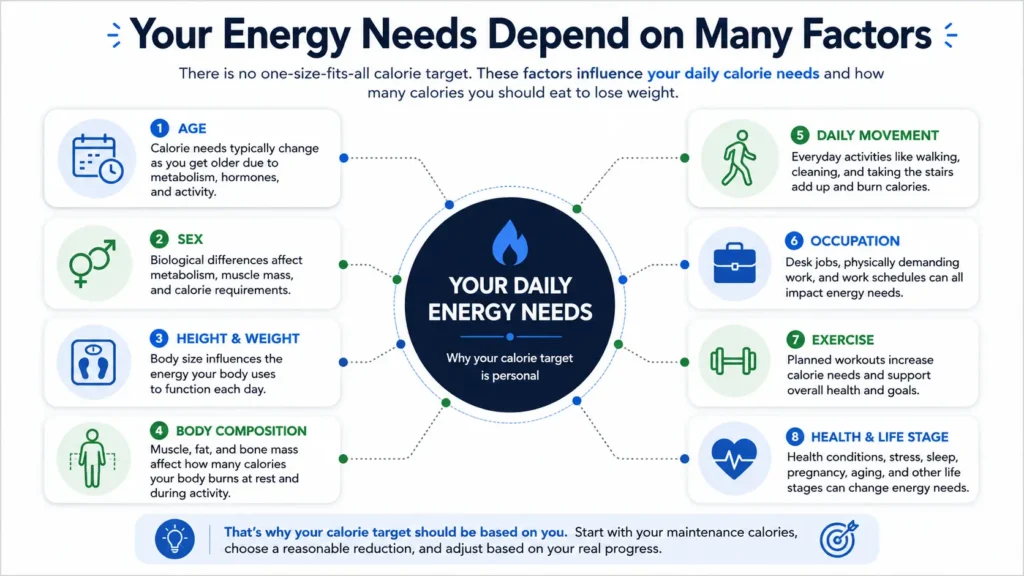
If you want to find your calorie deficit, do not begin with a random number from social media.Start with your estimated maintenance calories.Then choose a reasonable reduction and compare the estimate with your actual progress.This is also why a calories for weight loss calculation should begin with your own energy needs rather than a universal diet number.
Does a 500-Calorie Deficit Mean You Will Lose One Pound a Week?
Not necessarily. A 500-calorie daily deficit is often used as a simple rule of thumb, but it does not guarantee exactly one pound of weight loss every week.
You may have heard the old idea that 3,500 calories equals one pound of body fat.
From there, the math seems simple:
500 calories × 7 days = 3,500 calories
Real weight change is not that predictable.Research used in the NIH Body Weight Planner accounts for changes in energy expenditure that occur as calorie intake and body weight change.A fixed calculated deficit therefore does not guarantee a fixed rate of weight loss forever.The CDC notes that people who lose weight at a gradual, steady pace of about 1 to 2 pounds per week are more likely to keep weight off than people who lose weight more quickly.
That is general guidance, not a guarantee that a specific calorie reduction will produce an exact weekly result.
How Large Should Your Calorie Deficit Be?
The largest calorie deficit is not automatically the best one. A useful target should support progress while still allowing enough food for nutrition, daily activity, and a plan you can realistically maintain.
This is where fixed rules can cause problems.Imagine two people.One maintains their weight around 3,000 calories per day.Another maintains around 1,700.Cutting 500 calories creates a very different eating situation for each person.This is especially relevant for smaller adults and petite women, whose total energy needs may already be lower.
If your estimated target seems extremely low, do not keep cutting food simply to chase faster results.Individual factors matter, and a registered dietitian or qualified healthcare professional can help when a standard calculation produces an unusually restrictive target.
Why Your Real Calorie Deficit May Differ From the Calculation
Suppose your estimated TDEE is 2,500 calories and you log an average intake of 2,000.On paper, that is a 500-calorie gap.In real life, it may be different.
Your Maintenance Estimate May Be Off
TDEE equations make predictions.Activity level is particularly difficult to estimate.Someone who works out four times per week but sits at a desk all day may have different needs from someone who never visits a gym but walks, carries, and lifts for hours at work.
Food Intake Can Be Underestimated
Cooking oils, sauces, drinks, snacks, restaurant meals, and portion sizes can add more calories than expected.That does not mean you need to obsess over every bite.It simply means food tracking is not perfectly precise.
Your Activity Can Change
People do not burn the same amount every day.Steps, workouts, work demands, household tasks, and general movement all affect energy expenditure.
Your Energy Needs Can Change With Weight Loss
A smaller body generally requires less energy to maintain than a larger body.After meaningful weight loss, the maintenance estimate you started with may no longer fit as well as it once did.
Your starting number is an estimate, not a lifetime prescription.
Sedentary
Little or no exercise and a desk job.
Lightly Active
Light exercise or sports 1–3 days per week.
Moderately Active
Moderate exercise or sports 3–5 days per week.
Very Active
Hard exercise or sports 6–7 days per week.
Why Am I Not Losing Weight in a Calorie Deficit?
If the scale has not changed for a few days, that does not automatically mean your plan has failed.Short-term water changes can hide changes in body fat.
If your average weight remains unchanged over a meaningful period despite consistent tracking, the actual energy gap may be smaller than expected.
Common reasons include:
Common reasons progress may appear to stall
Your maintenance estimate was too high
Your actual daily energy needs may be lower than the original estimate.
Food intake was underestimated
Portions, cooking oils, drinks, snacks, or tracking errors can add up.
Daily movement decreased
You may be moving less throughout the day than when you first started.
Your energy needs changed
As body weight changes, your estimated calorie needs may also change.
Water weight is masking progress
Short-term changes in water retention can temporarily hide fat loss.
Before cutting more calories, review what you already know
Look at your data before making another large change to your calorie target.
Review whether your food portions are being estimated accurately.
Consider whether your daily movement has changed.
Look at your average habits rather than isolated days.
Focus on the longer-term trend instead of daily scale changes.
Sometimes the issue isn’t effort. Your original calorie estimate may simply need adjusting based on your actual progress.
Can You Create a Calorie Deficit Without Exercise?
Yes.
A calorie deficit can come from reducing energy intake, increasing energy expenditure, or combining both.You do not need to “burn off” every calorie you eat through workouts.Your body already uses energy to keep your organs working, digest food, regulate temperature, walk, work, and complete everyday tasks.
Exercise is only one part of your total daily expenditure.Physical activity still matters.It supports health and fitness and can play an important role in maintaining lost weight.For many people, manageable food changes combined with regular movement are more realistic than trying to create the entire deficit through exercise.
How to Eat in a Calorie Deficit Without Feeling Like You Are Starving
Eating fewer calories does not have to mean eating tiny meals all day.
Build Meals Around Protein
Protein supports muscle tissue and can help make meals satisfying.Sources include eggs, fish, poultry, Greek yogurt, cottage cheese, beans, lentils, and tofu.
Include Fiber-Rich Foods
Vegetables, fruits, legumes, and whole grains can add volume and nutrients to meals.
Watch Easy-to-Miss Calories
Cooking oils, sugar-sweetened drinks, specialty coffees, sauces, and frequent snacks can add up quickly.You do not have to ban them.Just account for them as part of your overall intake.
Choose an Approach You Can Repeat
A plan that feels perfect Monday through Thursday but falls apart every weekend may not create the average deficit you expected.Consistency over time matters more than having a “perfect” day.
How Can You Lose Weight While Protecting Muscle?
Weight loss and fat loss are not exactly the same thing.When losing weight, maintaining lean tissue is often an important goal.Resistance training can help support muscle and strength, while adequate dietary protein supports muscle tissue.Avoiding unnecessarily aggressive restriction may also make it easier to train, recover, and meet your nutritional needs.
Do not judge progress only by how fast the scale falls.Longer-term weight trends, waist measurements, strength, and how your clothes fit can provide useful context.
What Are the Benefits and Risks of Counting Calories?
Calorie tracking can help you understand portion sizes, serving sizes, eating habits, and how your intake compares with your estimated energy needs.t can also reveal easy-to-overlook sources such as cooking oils, drinks, sauces, and snacks.But tracking has limits.
Nutrition labels and food databases are not perfectly precise. Restaurant portions vary, and homemade meals can be difficult to measure accurately.Detailed tracking can also become stressful or overly restrictive for some people.You do not necessarily need to count every calorie forever.
Anyone with an eating disorder or history of disordered eating should seek appropriate professional guidance before using calorie restriction or detailed food tracking for weight management.
Frequently Asked Questions
Your estimated deficit is the difference between your average daily energy expenditure and calorie intake. For example, if your TDEE is about 2,400 calories and you average 2,000 calories, your estimated deficit is 400 calories per day. Your real-world weight trend helps show whether that estimate is close.
First estimate your TDEE or maintenance calories. Then subtract your average calorie intake. For example, 2,500 calories of estimated daily expenditure minus 2,100 calories of intake gives an estimated 400-calorie deficit.
No. A quick calorie deficit calc can give you a useful starting estimate, but it cannot directly measure your exact daily energy expenditure. Activity, food tracking, body-weight changes, and individual differences can cause actual results to differ from the calculation.
It may support weight loss if it reflects your actual energy balance, but it does not guarantee a specific weekly result. Your body size, activity, adherence, and changes in energy expenditure all affect what happens over time.
Do not force a large fixed deficit simply to hit two pounds every week. The CDC describes about 1 to 2 pounds per week as a gradual range commonly associated with sustainable weight loss, but an appropriate rate varies by person. Smaller people may not have enough room in their energy needs to create a large deficit without overly restricting intake.
It depends on your maintenance needs. For one person, 1,500 calories may create a reasonable deficit. For another, it may be too restrictive. The number should be evaluated against your individual energy needs, activity, health, and nutritional requirements.
There is no exact timeline that applies to everyone. Weight loss is not perfectly linear, and energy needs can change as body weight falls. Your starting weight, calorie intake, activity, health, adherence, and individual response all affect how long it takes.
Review your estimate after meaningful weight loss, a major change in activity or work demands, or when your weight trend has remained stable for several weeks despite consistent adherence. Do not recalculate simply because the scale did not move for a few days.
Standard adult weight-loss calculations may not be appropriate for teens because growth and development affect energy and nutrient needs. The NIH Body Weight Planner is intended for adults ages 18 and older. Teens seeking weight-management guidance should involve a parent or guardian and a qualified pediatric healthcare professional or registered dietitian.
Find Your Starting Point, Then Follow the Trend
If you came here thinking,
How do I calculate my calorie deficit?
remember that you need a reasonable maintenance estimate first.
Start there.
Find your starting point, then follow the trend.
Start with a reasonable estimate. Choose an appropriate intake below your estimated needs, follow it consistently, and compare the prediction with what actually happens over time.
The best deficit is not simply the biggest one you can tolerate. It is one that supports progress, adequate nutrition, and an approach you can realistically maintain.
Start by estimating your daily energy needs with our calculator, then use the guidance in this article to understand the calorie gap that fits your weight-loss plan.
Free TDEE Calculator to Estimate Your Daily Calorie Needs →Health and Safety Note
This article is for general educational purposes and is not individualized medical or nutrition advice.
General calorie-deficit calculations may not be appropriate for people under 18, people who are pregnant or breastfeeding, people with medical conditions affecting nutrition or metabolism, athletes with specialized fueling needs, or anyone with an eating disorder or history of disordered eating.