
Harris-Benedict Equation: Formula, Calculation and Accuracy
Last Updated: August 2026
The Harris-Benedict equation estimates how many calories your body uses at rest, based on your age, sex, height, and weight.
Most calculators don’t tell you which version of the formula they’re using, and that’s the detail that actually explains why two “Harris-Benedict calculators” can give you different numbers. Harris and Benedict published their original work in 1919. In 1984, researchers Roza and Shizgal reevaluated the data and published revised equations with different coefficients. This page shows you both, tells you which one it uses by default, and explains why the distinction matters.
The result, either way, is an estimate — not an exact measurement of your metabolism or an automatic calorie target.
What Is the Harris-Benedict Equation?
It’s a predictive formula that estimates your basal energy needs from age, sex, height, and weight. Your body uses energy even at rest. Your heart beats, your lungs breathe, and your brain and organs keep working, and the energy required for that is your Basal Metabolic Rate (BMR). For a fuller explanation, see our BMR Guide.
The key distinction: Harris-Benedict estimates resting energy only. It does not calculate everything you burn during a normal day that’s a separate step, covered below.
Original vs. Revised Harris-Benedict: Why the Difference Matters
This is where the history directly affects your number.
James Arthur Harris and Francis Gano Benedict published A Biometric Study of Basal Metabolism in Man through the Carnegie Institution of Washington in 1919. In 1984, researchers Roza and Shizgal reevaluated that data and published revised equations with different coefficients. In 1990, Mifflin and colleagues published a separate, newer predictive method, the Mifflin-St Jeor equation.
| Method | Published | What You Should Know |
|---|---|---|
| Original Harris-Benedict | 1919 | The historical original coefficients |
| Revised Harris-Benedict | 1984 | Roza and Shizgal revised the coefficients using updated data |
| Mifflin-St Jeor | 1990 | A separate, newer predictive equation, often preferred today |
Why this page makes the distinction: If two websites return different results for identical age, weight, height, and sex, check which equation each one uses before assuming a calculator is broken. Some use the original 1919 formula. Others use the 1984 revision. Few tell you which.
What Is the Revised Harris-Benedict Equation?
The 1984 Roza and Shizgal equations use different coefficients for men and women to estimate resting energy expenditure. This is the version most modern tools mean when they say “Harris-Benedict.”
Formula for Men
BMR = 88.362 + (13.397 × weight in kg) + (4.799 × height in cm) − (5.677 × age)
Formula for Women
BMR = 447.593 + (9.247 × weight in kg) + (3.098 × height in cm) − (4.330 × age)
The result is an estimated number of calories used per day at rest. If your measurements are in pounds and inches:
Centimeters = inches × 2.54
Kilograms = pounds ÷ 2.2046
How to Calculate Your BMR: A Worked Example
Susan Miller
Fictional example · 45 years old · 165 lbs · 5’5″
Convert measurements
165 ÷ 2.2046 = 74.8 kg
65 × 2.54 = 165.1 cm
Apply the revised formula for women
447.593 + (9.247 × 74.8) + (3.098 × 165.1) − (4.330 × 45)
= approximately 1,456 calories per day
Susan’s estimated resting energy requirement is about 1,456 calories per day. This is a starting estimate of resting energy needs, not a personal calorie prescription. Her actual daily energy expenditure also includes walking, working, eating, household tasks, and other movement.
How Do You Turn BMR Into Estimated Daily Calorie Needs?
Multiply your estimated resting energy by an activity factor to approximate total daily energy expenditure (TDEE).
| Activity Category | Common Multiplier |
|---|---|
| Sedentary | 1.2 |
| Lightly active | 1.375 |
| Moderately active | 1.55 |
| Very active | 1.725 |
| Extra active | 1.9 |
If Susan’s resting estimate is 1,456 calories and her activity multiplier is 1.375:
1,456 × 1.375 = approximately 2,002 calories per dayThat second number estimates her broader daily expenditure. It is not her BMR. For a dedicated total-energy estimate, use FREE TDEE Calculator.
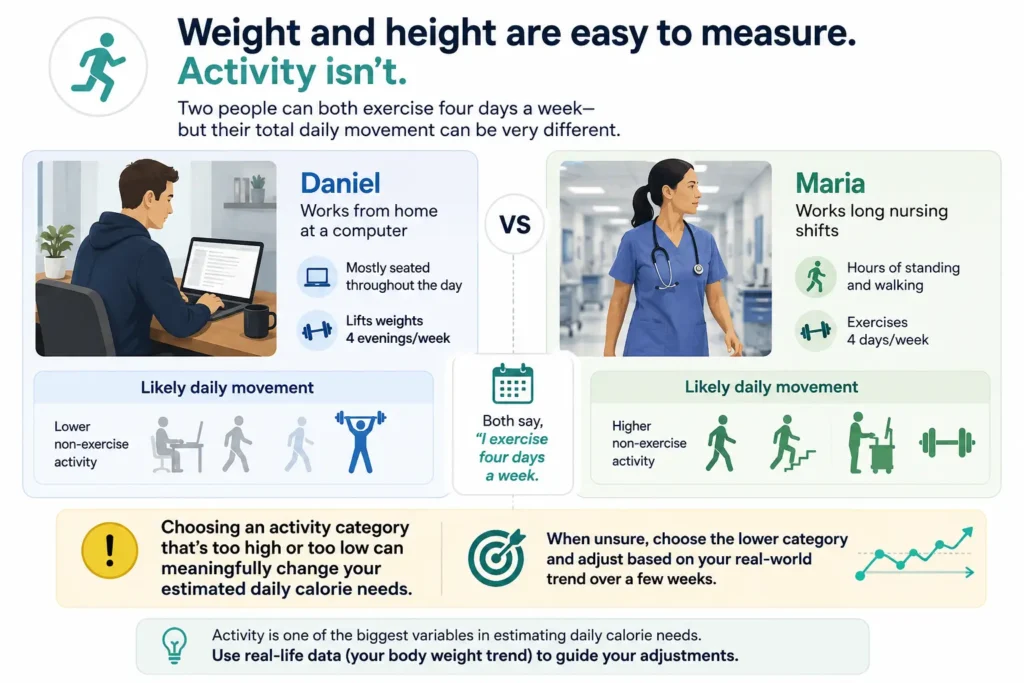
Your Activity Level May Be the Hardest Number to Get Right
Weight and height are easy to measure. Activity isn’t.
Consider two fictional people. Daniel works from home at a computer and lifts weights four evenings a week. Maria also exercises four days a week, but works long nursing shifts involving hours of standing and walking.
Both could say “I exercise four days a week.” Their total daily movement is likely very different.
Choosing an activity category that’s too high or too low can meaningfully change your estimated daily calorie needs. When unsure, choose the lower category and adjust based on your real-world trend over a few weeks.
BMR vs. TDEE: Don’t Confuse the Two Numbers
BMR estimates resting energy needs. TDEE estimates your total energy expenditure across the full day.
| BMR | TDEE |
|---|---|
| Focuses on resting energy | Focuses on total daily expenditure |
| Does not represent a normal active day | Accounts for daily movement and activity |
| A starting estimate | More useful for maintenance planning |
| Not automatically a calorie target | Provides context for calorie planning |
If your BMR is 1,500 calories, that does not mean your body only burns 1,500 calories in a full day.
How Accurate Is the Harris-Benedict Equation?
It provides a useful starting estimate, but it can’t tell you exactly how many calories your individual body burns.
Roza and Shizgal’s 1984 reevaluation reported a prediction precision of about 14% for normal subjects in their analysis. Other research comparing predictive equations against measured resting energy expenditure has also found accuracy varies between individuals and populations.
So if your result reads 1,700 calories per day, don’t interpret that as “my body definitely burns exactly 1,700 calories at rest.” A better read: “Based on my measurements and this equation, my resting energy needs are estimated to be around this level.”
The number looks exact. The estimate is not. Body composition, age, health, individual biology, and differences between study populations can all affect how closely a prediction matches your actual measured energy expenditure.
When a more direct clinical assessment is needed, indirect calorimetry estimates energy expenditure using respiratory gas measurements. A formula predicts. Indirect calorimetry measures more directly.
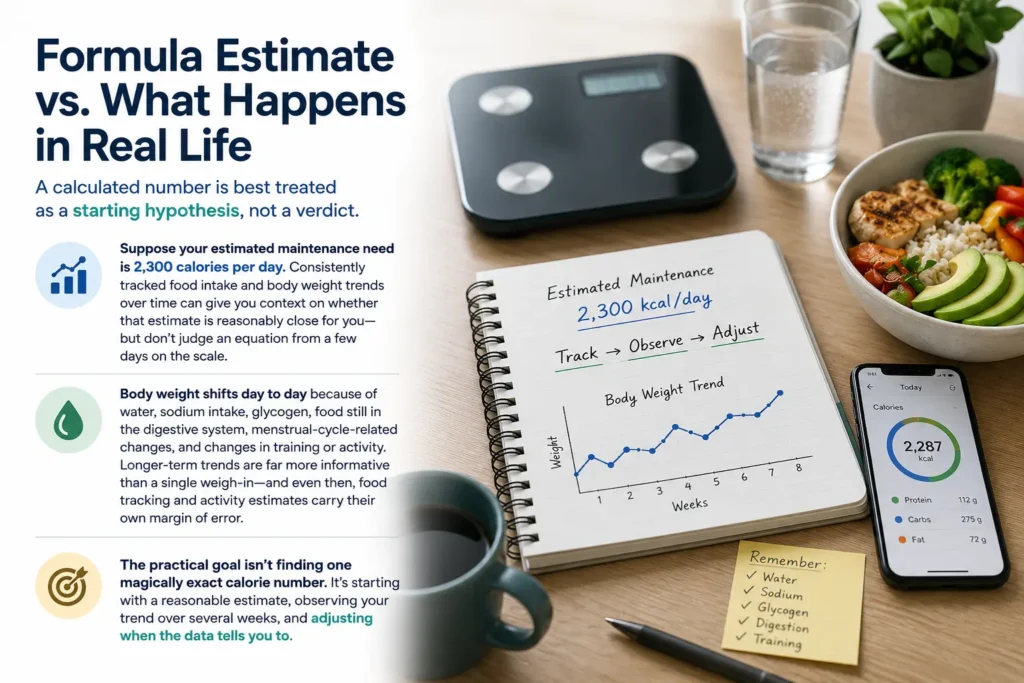
Formula Estimate vs. What Happens in Real Life
A calculated number is best treated as a starting hypothesis, not a verdict.
Suppose your estimated maintenance need is 2,300 calories per day. Consistently tracked food intake and body weight trends over time can give you context on whether that estimate is reasonably close for you—but don’t judge an equation from a few days on the scale.
Body weight shifts day to day because of water, sodium intake, glycogen, food still in the digestive system, menstrual-cycle-related changes, and changes in training or activity. Longer-term trends are far more informative than a single weigh-in—and even then, food tracking and activity estimates carry their own margin of error.
The practical goal isn’t finding one magically exact calorie number. It’s starting with a reasonable estimate, observing your trend over several weeks, and adjusting when the data tells you to.
Harris-Benedict vs. Mifflin-St. Jeor: Which Should You Use?
Both predict resting energy expenditure, but from different data.
A systematic review by Frankenfield and colleagues found Mifflin-St Jeor was more likely than the other equations examined to estimate resting metabolic rate within 10% of measured values. That doesn’t make it exact for everyone, no predictive equation is best for every person or population. A difference between formulas doesn’t mean one is broken; it means you’re comparing two different prediction models.
What Are the Main Limitations?
It’s not a standalone method for everyone. Children, pregnancy, breastfeeding, unusual athletic body composition, and some medical situations may need individualized methods. It predicts rather than measures. Your personal metabolism wasn’t tested in a lab.
Body composition isn’t a direct input. Two people with identical age, height, weight, and sex can still differ meaningfully in lean mass and body fat.
Activity adds uncertainty. A poorly chosen activity category can push your final estimate meaningfully higher or lower. It’s not a medical test. It cannot diagnose thyroid disease, metabolic disorders, or the cause of unexplained weight change.
Can You Use the Harris-Benedict Formula for Weight Loss?
Yes, as one starting point, but BMR alone should never become your weight-loss calorie target.
The path:
Estimate resting energy → estimate total daily expenditure → set intake based on your goal.
Suppose Mark, a fictional example, has a BMR estimate of 1,750 calories. That does not mean
“Mark should eat 1,750 calories to lose weight”; his total daily energy needs are likely considerably higher.
Use TDEE calculation tool to estimate broader daily expenditure, then read our Calorie Deficit Guide to understand how an energy deficit relates to weight loss
Frequently Asked Questions
They may use different formula versions — the 1919 original versus the 1984 revision. Rounding, unit conversion, and activity assumptions can also affect results.
It provides a useful estimate, but individual error is possible. Treat predictive equations as estimates, not exact measurements of personal metabolism.
No formula is perfectly accurMifflin-St Jeor is often preferred for modern general estimation and has performed well in comparative research, but neither method predicts every individual perfectly.ate for everyone. A reliable calculator uses an established equation like Mifflin St Jeor, accounts for activity level, and clearly states its limitations. Use the result as a starting point — not a fixed prescription.
Yes, as one starting estimate. First distinguish resting energy from total daily expenditure — don’t treat BMR itself as an automatic weight-loss target.
BMR alone can’t answer that. Total daily needs are generally higher once movement and activity are included, and your appropriate intake depends on your total needs, health, and goal.
Standard adult formulas shouldn’t be relied on as a standalone method for a child’s calorie needs — growth and development change the calculation. Use age-appropriate assessment instead.
Key Takeaways
-
01
Mifflin-St Jeor is often preferred today, but no predictive equation is exact for everyone.
-
02
Harris-Benedict predicts resting energy needs from age, sex, height, and weight.
-
03
The original (1919) and revised (1984) equations are different — that’s often why calculator results conflict.
-
04
A BMR estimate is not the same as TDEE or an automatic calorie target.
-
05
Activity level is a major source of uncertainty in the final daily estimate.
-
06
A precise-looking result is still a prediction, not a measurement.
References
-
1
Academy of Nutrition and Dietetics Evidence Analysis Library. Evidence reviews related to resting metabolic rate and predictive energy equations.
-
2
Harris JA, Benedict FG. A Biometric Study of Basal Metabolism in Man. Carnegie Institution of Washington. 1919.
-
3
Roza AM, Shizgal HM. The Harris-Benedict Equation Reevaluated: Resting Energy Requirements and the Body Cell Mass. American Journal of Clinical Nutrition. 1984;40(1):168–182.
-
4
Mifflin MD, St Jeor ST, Hill LA, Scott BJ, Daugherty SA, Koh YO. A New Predictive Equation for Resting Energy Expenditure in Healthy Individuals. American Journal of Clinical Nutrition. 1990;51(2):241–247.
-
5
Frankenfield D, Roth Y, Compher C. Comparison of Predictive Equations for Resting Metabolic Rate in Healthy Nonobese and Obese Adults: A Systematic Review. Journal of the American Dietetic Association. 2005;105(5):775–789.