
Mifflin St Jeor Calculator: Formula, How to Calculate BMR & Accuracy
Last Updated: August 2026
The Mifflin-St Jeor equation estimates how much energy your body uses at rest from four basic inputs: your weight, height, age, and sex.
Published in 1990, the equation is widely used as a starting point for estimating resting energy needs. A Mifflin St Jeor calculator simply performs this math automatically.
One distinction is important:
Mifflin St Jeor estimates resting energy expenditure. Applying an activity multiplier to estimate Total Daily Energy Expenditure, or TDEE, is a separate step.
This means your final daily calorie estimate has at least two possible sources of uncertainty: the equation itself and the activity level used afterward.
What Is the Mifflin St Jeor Equation?
The Mifflin St Jeor equation is a predictive formula developed by Mifflin and colleagues and published in the American Journal of Clinical Nutrition in 1990. It uses body weight, height, age, and sex to estimate resting energy expenditure.
Your body uses energy even when you are not exercising. Your heart keeps beating, your lungs keep working, your brain remains active, and your organs and tissues continue carrying out essential functions.
Online calculators often label this resting estimate as BMR, although basal metabolic rate and resting metabolic rate are not technically identical measurements because true basal measurement requires stricter testing conditions.
For a fuller explanation, read What Is BMR?
The practical point is simple:
Mifflin St Jeor predicts your resting energy needs. It does not directly calculate everything you burn during a normal day.
What Is the Mifflin St Jeor Formula?
The commonly used equations are:
For Men
For Women
The result is expressed in approximately kilocalories per day, commonly called calories per day in everyday nutrition language.
If You Use Pounds and Inches
Keep the full values while doing the math and round the final result. Rounding every step can create small differences between calculations.
How Do You Calculate Mifflin St Jeor?
Here is a simple example using Pete Miller, a fictional 36-year-old man.
Weight: 183 pounds Height: 6 feet 1 inch Age: 36
First, convert his measurements:
183 ÷ 2.2046 = about 83.0 kg
73 inches × 2.54 = 185.42 cm
Now use the formula for men:
(10 × 83.0) + (6.25 × 185.42) − (5 × 36) + 5
Pete’s estimated resting energy expenditure is approximately:
1,814 calories per day
This does not mean Pete should automatically eat 1,814 calories each day.
His body also uses energy when he walks, works, digests food, exercises, completes household tasks, and moves through daily life.
Think of the result as a starting estimate of resting energy needs, not a complete calorie prescription.
How Do You Turn Mifflin St Jeor Into TDEE?
A common approach is to estimate resting energy first and then apply an activity factor to approximate Total Daily Energy Expenditure.
Common activity multipliers include:
| Activity Category | Common Multiplier |
|---|---|
| Sedentary | 1.2 |
| Lightly active | 1.375 |
| Moderately active | 1.55 |
| Very active | 1.725 |
| Extra active | 1.9 |
The second number is an estimated TDEE. It is not Pete’s new BMR.
The activity multiplier is not part of the core Mifflin-St Jeor equation. It is an additional estimation step used to approximate total daily energy expenditure.
For a dedicated estimate of your broader daily energy needs, use our TDEE Calculator
How Do You Choose the Right Activity Level?
Choosing an activity category may be harder than doing the equation itself.Consider three fictional people.
Sarah works at a desk, drives most places, and completes two short workouts each week.
James works in sales, walks between appointments, stays on his feet more often, and trains several days per week.
Emma trains for triathlons and regularly completes longer swimming, cycling, and running sessions.
Simply asking “How many days a week do you exercise?” does not capture those differences.
Your job, daily walking, commuting habits, training duration, exercise intensity, and general movement all contribute to your total activity.Someone who lifts weights four times per week but sits at a computer for most of the day may have different energy needs from a hospital worker who also trains four times per week but spends long shifts walking and standing.
Treat activity categories as broad estimates, not precise measurements of how many calories you burn.
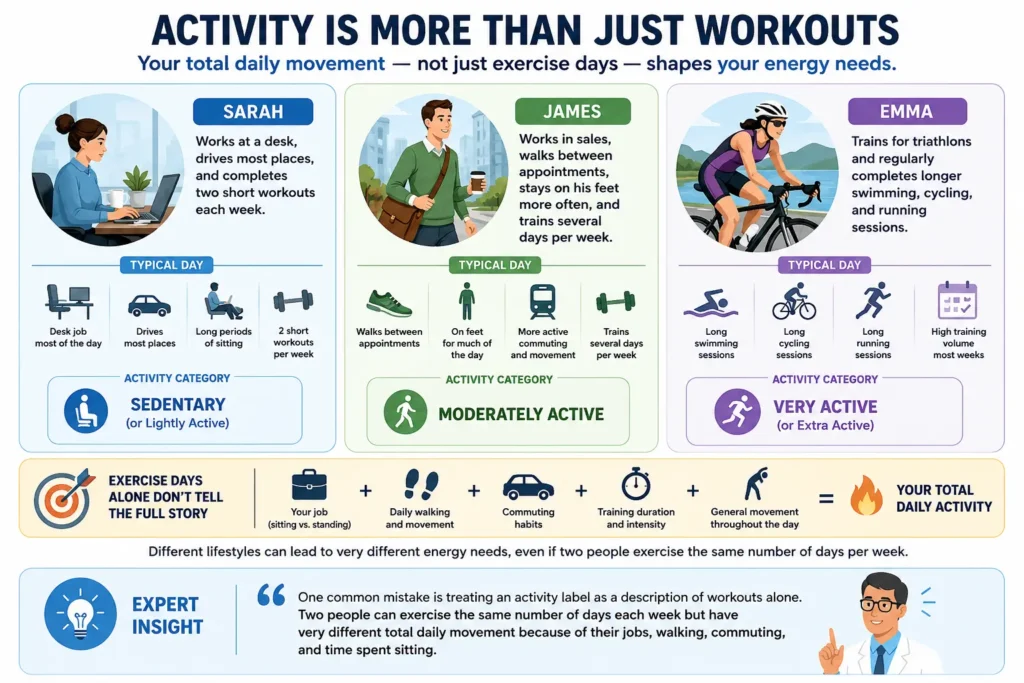
Expert Insight
“One common mistake is treating an activity label as a description of workouts alone. Two people can exercise the same number of days each week but have very different total daily movement because of their jobs, walking, commuting, and time spent sitting.”
Where Can Your Calorie Estimate Go Wrong?
There are two main layers of uncertainty. The equation predicts resting energy rather than measuring it directly, and the activity adjustment used to estimate TDEE is another prediction — and real-world tracking can help you judge both, if read carefully.
Mifflin St Jeor was developed from population data. Your actual resting energy expenditure may therefore be higher or lower than the calculated result. Even if your resting estimate is reasonably close, choosing an activity category that does not reflect your actual lifestyle can push the final TDEE estimate higher or lower. Equation error and activity-factor error are not the same thing — a result can be off because of either one, or both.
Suppose the equation estimates your resting needs reasonably well, but you choose “very active” because you train four days per week while spending most of your workday sitting. Your final TDEE could still be overestimated because the activity assumption, not necessarily the core equation, missed your actual daily movement.
Real-world trends can provide additional context, used carefully. If your estimated maintenance need is 2,400 calories per day, consistently tracked food intake and body-weight trends over several weeks may help you judge whether that starting estimate appears reasonably close. Do not use a few scale readings as proof that an equation is right or wrong — short-term body weight can change because of water balance, sodium intake, glycogen, food in the digestive system, menstrual-cycle related changes, and shifts in activity. Food logging and exercise-calorie estimates can also contain error.
The practical approach is to start with a reasonable estimate, observe longer-term patterns, and adjust when appropriate rather than treating one calculated number as permanently exact.
How Accurate Is the Mifflin St Jeor Equation?
Mifflin St Jeor is one of the better-studied predictive equations for estimating resting energy needs in adults, but it is not exact for every person.
A systematic review by Franken field and colleagues compared commonly used equations with measured resting metabolic rate. The researchers found that Mifflin St Jeor was more likely than the other equations they examined to estimate resting metabolic rate within 10% of measured values in the populations studied.
That finding should not be interpreted as “Mifflin St Jeor is always accurate within 10%.” Individual errors still occur. Accuracy can vary with body composition, weight status, age, health, and characteristics of the population being assessed.
If your calculated result is 1,700 calories per day, the useful interpretation is “my resting energy needs are estimated to be around this level” not “my body definitely burns exactly 1,700 calories at rest.”
A calculator can return a precise number without providing a perfectly precise prediction.
When more direct clinical assessment is needed, indirect calorimetry can estimate energy expenditure using measurements of respiratory gases.
Source: Frankenfield D, Roth-Yousey L, Compher C. Comparison of Predictive Equations for Resting Metabolic Rate in Healthy Nonobese and Obese Adults: A Systematic Review. J Am Diet Assoc. 2005;105(5):775–789.
Mifflin St Jeor vs. Harris Benedict: What’s the Difference?
Both methods predict resting energy needs, but they use different equations developed from different research datasets.
Comparative research has often supported Mifflin-St Jeor as a useful equation for estimating resting energy needs in adults. That does not mean it is universally more accurate for every person.
For a detailed comparison of the original and revised formulas, read our Harris Benedict Equation Guide
Who May Need More Than a Standard Equation?
Standard predictive equations are useful starting points, but they may not be enough for every person or situation.
Extra care may be needed for:
- Children and adolescents
- Pregnancy and breastfeeding
- Certain medical conditions
- People with unusual or highly muscular body composition
- Clinical nutrition situations requiring more precise assessment
Pregnancy, for example, changes energy requirements over time. A standard adult equation alone should not be used as a complete pregnancy calorie prescription. Likewise, an online equation cannot diagnose why someone has unexplained weight changes or unusual energy needs.
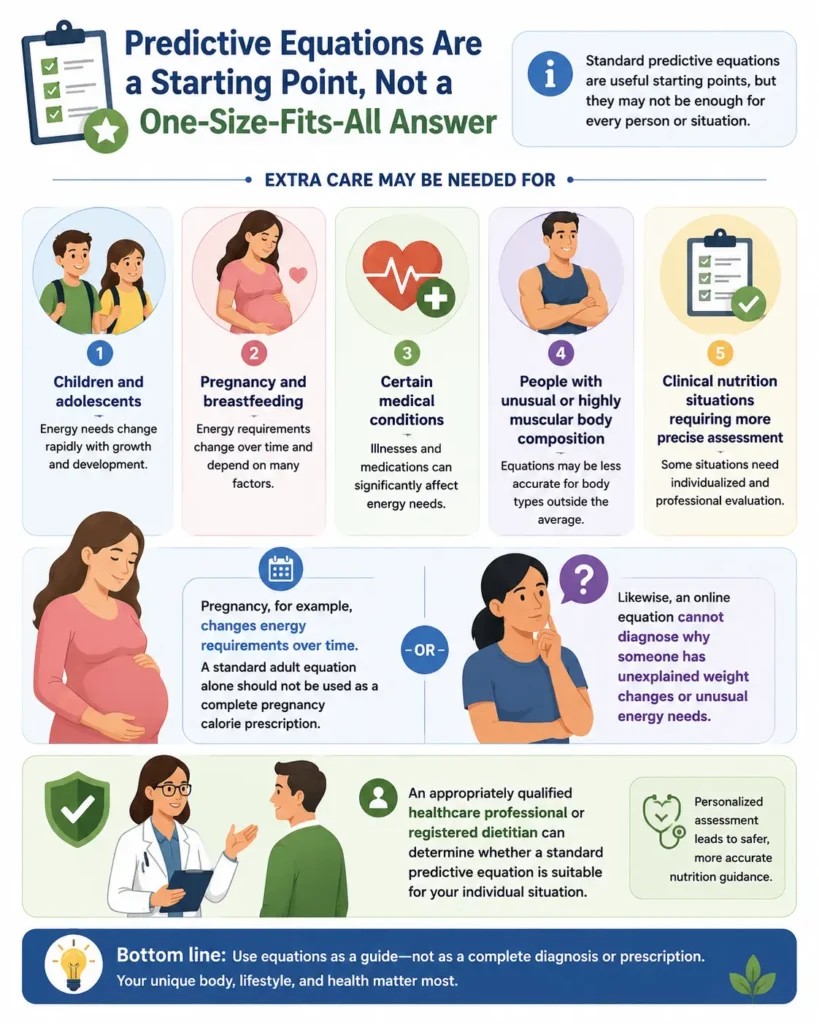
An appropriately qualified healthcare professional or registered dietitian can determine whether a standard predictive equation is suitable for your individual situation.
Frequently Asked Questions
The Mifflin St Jeor equation is a predictive formula that uses weight, height, age, and sex to estimate resting energy expenditure. It was published by Mifflin and colleagues in 1990.
It performs the equation automatically to estimate resting energy needs. That estimate can then serve as one input when approximating broader daily calorie requirements.
The core equation predicts resting energy expenditure. Estimating TDEE requires an additional adjustment for activity and broader daily energy use.
Results may differ because of rounding, unit conversions, activity assumptions, or whether a calculator reports resting energy alone or an activity-adjusted TDEE. Check what each calculator is actually showing before comparing the numbers.
Mifflin St Jeor has performed well in comparative research and is commonly used for adult resting-energy estimation. However, neither equation predicts every individual’s energy expenditure perfectly.
A resting estimate of 1,700 calories does not automatically tell you how much you should eat. Your total daily energy needs also include energy used through movement and other daily activities. Appropriate calorie intake also depends on your health and goals.
It can provide a starting estimate, but accuracy varies among individuals and populations. A calculated result should not be assumed to match directly measured resting energy expenditure.
A standard adult equation alone should not be used to determine pregnancy calorie needs. Energy requirements change during pregnancy and should be considered using appropriate pregnancy-specific guidance and individual health factors.
Key Takeaways
Mifflin-St Jeor uses weight, height, age, and sex to predict resting energy expenditure.
The equation estimates resting energy, not your complete daily calorie burn.
Applying an activity multiplier to estimate TDEE is a separate step.
Equation error and activity-factor error are two different sources of uncertainty.
Mifflin-St Jeor has performed well in comparative research, but no predictive equation is exact for every individual.
A precise-looking calculator result should still be treated as an estimate.
Longer-term real-world trends can provide useful context when interpreted carefully.
References
- Mifflin MD, St Jeor ST, Hill LA, Scott BJ, Daugherty SA, Koh YO. A New Predictive Equation for Resting Energy Expenditure in Healthy Individuals. Am J Clin Nutr. 1990;51(2):241–247.
- Frankenfield D, Roth-Yousey L, Compher C. Comparison of Predictive Equations for Resting Metabolic Rate in Healthy Nonobese and Obese Adults: A Systematic Review. J Am Diet Assoc. 2005;105(5):775–789.
- Roza AM, Shizgal HM. The Harris Benedict Equation Reevaluated: Resting Energy Requirements and the Body Cell Mass. Am J Clin Nutr. 1984;40(1):168–182.
- Harris JA, Benedict FG. A Biometric Study of Basal Metabolism in Man. Carnegie Institution of Washington; 1919.
Health and Editorial Disclaimer
This article is for general educational purposes and does not provide individualized medical or nutrition advice.
Predictive energy equations may not be suitable for every person or clinical situation. If you have unexplained weight changes, pregnancy or breastfeeding related nutrition needs, an eating disorder or history of disordered eating, or a medical condition that may affect energy requirements, seek guidance from an appropriately qualified healthcare professional.