
Calorie Calculator to Gain Weight: How Many Calories You Need for a Caloric Surplus
Last Updated: August 2026
A calorie calculator to gain weight starts with your maintenance calories (TDEE), then adds a caloric surplus , extra calories above what your body burns — to support weight gain. Most healthy adults do well starting with 250–500 extra calories per day, adjusted based on training experience and how fast they want to gain.
What Is a Caloric Surplus?
A caloric surplus means eating more calories than your body uses in a day. That extra energy gives your body the resources to build new tissue — primarily muscle when paired with resistance training, and some fat.
Caloric Surplus = Total Daily Calorie Intake == TDEE
If your TDEE is 2,500 calories and you eat 2,900, your daily surplus is 400 calories.
There’s no single number that works for everyone, the right surplus depends on your current weight, training experience, activity level, and how quickly you want to gain. Before calculating your surplus, you need your maintenance calories(TDEE) to estimate yours first.
How Big Should Your Calorie Surplus Be?
Research-backed guidance points to a surplus of roughly 10–20% above maintenance for novice and intermediate lifters, with more advanced lifters staying closer to the lower end.
A 2019 review by Iraki and colleagues, published in the journal Sports, found that a surplus in the 10–20% range above maintenance supports muscle growth while limiting unnecessary fat gain. On a 2,500-calorie maintenance level, that works out to roughly 250–500 extra calories daily — which is why this range shows up repeatedly across reputable weight-gain guidance.
Your body’s capacity to build muscle is also capped. Research by Helms and colleagues (2014) found that even under ideal conditions, most people gain no more than about 0.2–0.5 kg (0.4–1 lb) of muscle per month. Any surplus beyond what your body can actually use for muscle synthesis gets stored as fat a bigger surplus doesn’t mean faster muscle gain, just more fat gain.
Suggested Starting Surplus by Body Weight
These ranges can provide a practical starting point when planning a calorie surplus.
Men
Moderately Active — Exercise 3–5x/Week
| Body Weight | Suggested Daily Surplus |
|---|---|
| 120–140 lb | 250–300 cal |
| 141–170 lb | 250–350 cal |
| 171–200 lb | 300–400 cal |
| Over 200 lb | 350–500 cal |
Women
Moderately Active — Exercise 3–5x/Week
| Body Weight | Suggested Daily Surplus |
|---|---|
| 100–120 lb | 200–250 cal |
| 121–150 lb | 250–300 cal |
| 151–180 lb | 250–350 cal |
| Over 180 lb | 300–450 cal |
Suggested Surplus by Training Experience
Your training background can also influence where you start.
Keep the Ranges Flexible
Beginners typically build muscle more efficiently than experienced lifters, so a smaller surplus usually works better early on. Treat these numbers as starting points, not fixed rules — some people respond well to a smaller surplus, while others need slightly more to see consistent progress.
Suggested Surplus by Training Experience
Beginners typically build muscle more efficiently than experienced lifters, so a smaller surplus usually works better for them early on. Treat these as starting points, not fixed rules, some people respond well to a smaller surplus, others need slightly more to see consistent progress.
Keeping Your Surplus Lean-Gain Friendly
Eating more doesn’t automatically mean building more muscle. Muscle growth depends on several factors working together: progressive resistance training, enough daily protein, adequate total calories, sleep, and recovery.
A moderate surplus of 250–350 calories, paired with structured training, typically produces steadier, leaner progress than adding 1,000 calories a day. The goal isn’t to make the scale move fast, it’s to improve body composition over time.
Protein, fat, and carbs each play a distinct role beyond total calories: protein supports muscle repair, fat supports hormone production, and carbs fuel training. For specific daily targets, see our Macro Calculator and Protein Calculator.
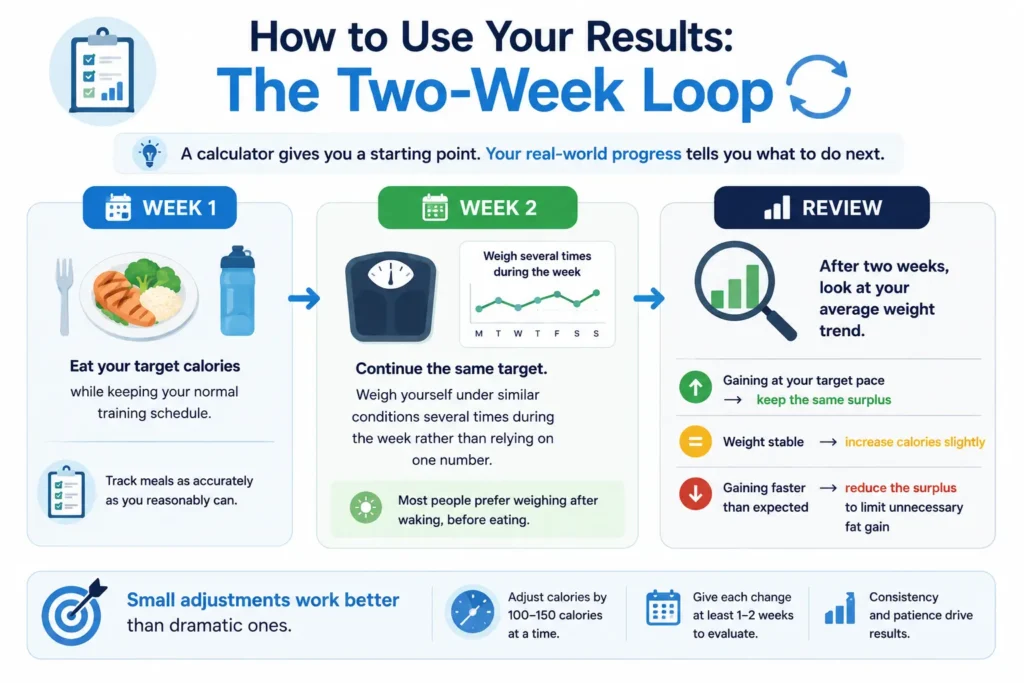
How to Use Your Results: The Two-Week Loop
A calculator gives you a starting point. Your real-world progress tells you what to do next.
Week 1: Eat your target calories while keeping your normal training schedule. Track meals as accurately as you reasonably can.
Week 2: Continue the same target. Weigh yourself under similar conditions several times during the week rather than relying on one number — most people prefer weighing after waking, before eating.
Review: After two weeks, look at your average weight trend.
- Gaining at your target pace → keep the same surplus
- Weight stable → increase calories slightly
- Gaining faster than expected → reduce the surplus to limit unnecessary fat gain
Small adjustments work better than dramatic ones.
What This Calculator Doesn’t Capture
No online calculator can fully account for body fat percentage, muscle mass, medical conditions, pregnancy or breastfeeding, medications, metabolic adaptation, or sleep and recovery quality. For some people, indirect calorimetry or personalized nutrition assessment may give a more accurate starting point than a predictive formula alone.
Frequently Asked Questions
Estimate your maintenance calories (TDEE) using your age, sex, height, weight, and activity level, then add a moderate surplus — typically 10–20% above maintenance, or 250–500 calories for most adults. Adjust based on your weight trend over 2–3 weeks.
Most healthy adults do well with 250–500 extra calories daily. Beginners often need less (200–300 cal); advanced lifters may need slightly more, though research supports staying conservative to limit fat gain.
No calculator can guarantee muscle gain — it estimates a starting calorie target. Actual growth also depends on resistance training, protein intake, sleep, and recovery, and is capped at roughly 0.2–0.5 kg per month even under ideal conditions.
A weight gain calculator adds a calculated surplus on top of your estimated maintenance calories (TDEE), while a standard calorie calculator typically shows maintenance or deficit targets instead.
Gradual gain — roughly 0.25–0.5 kg (0.5–1 lb) per week — combined with resistance training generally produces a better muscle-to-fat ratio than rapid weight gain.
Gradual gain — roughly 0.25–0.5 kg (0.5–1 lb) per week — combined with resistance training generally produces a better muscle-to-fat ratio than rapid weight gain.
Standard adult surplus calculations aren’t appropriate for teens, since growth and development affect energy needs. Guidance should come from a qualified healthcare professional.
Key Takeaways
Review your average weight every two weeks and adjust in small increments.
A caloric surplus means eating more calories than your body uses.
Estimate maintenance calories (TDEE) before adding a surplus.
Research supports a 10–20% surplus above maintenance for most lifters — roughly 250–500 calories for most adults.
Muscle gain is capped at about 0.2–0.5 kg per month even in ideal conditions; extra calories beyond that mostly add fat.
References
- Iraki J, Fitschen P, Espinar S, Helms E. Nutrition Recommendations for Bodybuilders in the Off-Season: A Narrative Review. Sports. 2019;7(7):154.
- Helms ER, Aragon AA, Fitschen PJ. Evidence-Based Recommendations for Natural Bodybuilding Contest Preparation. Journal of the International Society of Sports Nutrition. 2014;11:20.
- Mifflin MD, St Jeor ST, Hill LA, Scott BJ, Daugherty SA, Koh YO. A New Predictive Equation for Resting Energy Expenditure in Healthy Individuals. American Journal of Clinical Nutrition. 1990;51(2):241–247.
- Academy of Nutrition and Dietetics. Nutrition guidance for healthy weight management and energy balance.
Medical Disclaimer
This article is for educational purposes only and does not replace professional medical advice. If you have a medical condition, are pregnant or breastfeeding, are recovering from illness, or have unexplained weight changes, consult a qualified healthcare professional before making significant dietary changes.