
Calorie Calculator: How Many Calories Should You Eat a Day?
Last Updated: August 2026
A calorie calculator estimates how much energy your body needs each day based on age, sex, height, weight, and activity level. Your goal then determines whether you eat near that estimate to maintain weight, below it to lose weight, or above it to gain weight.
Your calorie needs are personal. A desk worker and a construction worker of identical age and size can have very different daily energy needs depending on how much they move, lift, and exert themselves throughout the day.
Want your personal starting point? Use our TDEE Tool to estimate how much energy your body uses in a typical day.
What Are Calories?
A calorie is a unit of energy. In nutrition, calories tell us how much energy food and drinks provide to the body.
Most food energy comes from three macronutrients
Alcohol provides about 7 kcal per gram but is not an essential nutrient. On U.S. Nutrition Facts labels, “Calories” means kilocalories (kcal). Your body uses this energy continuously — to keep your heart beating, fuel digestion, power movement, and support every organ.
Do All Calories Affect Your Body the Same Way?
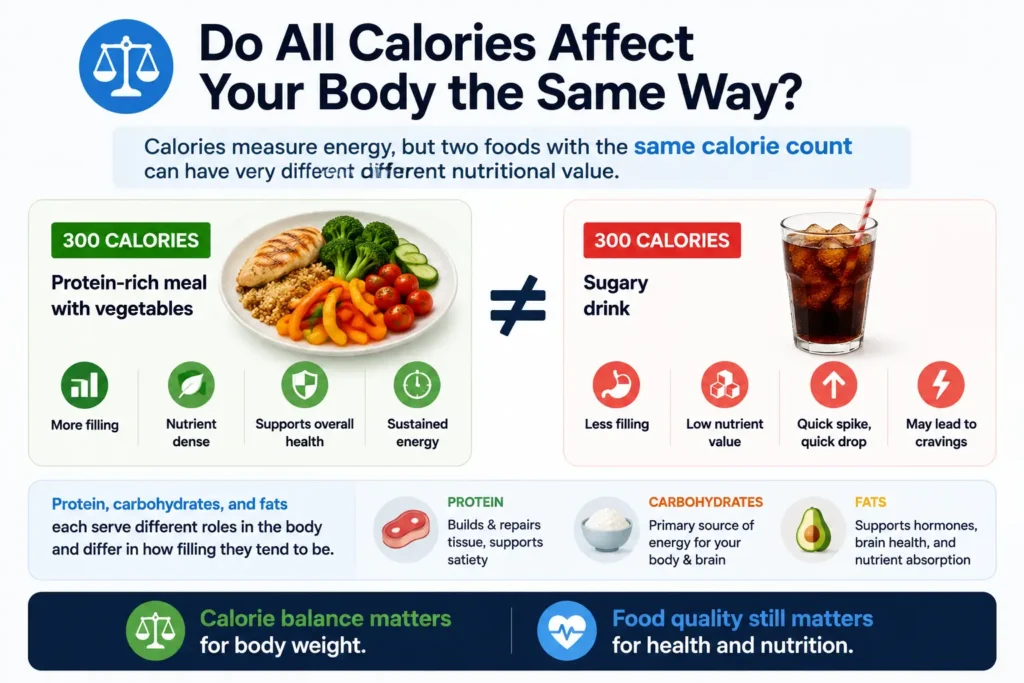
Calories measure energy, but two foods with the same calorie count can have very different nutritional value.
300 calories from a protein-rich meal with vegetables is not the same as 300 calories from a sugary drink, in terms of fullness, nutrients, or how your body responds. Protein, carbohydrates, and fats each serve different roles in the body and differ in how filling they tend to be.
Calorie balance matters for body weight. Food quality still matters for health and nutrition.
How Are Daily Calorie Needs Calculated?
Your daily calorie needs reflect the energy your body uses for basic functions, everyday movement, and physical activity. Age, sex, height, weight, body composition, and activity level can all affect that number.
Using an online calorie calculator is the fastest way to get a starting estimate without doing the math manually.
Most estimates follow two steps.
Step 1: A predictive equation estimates resting energy needs — how much energy your body uses at rest.
Step 2: An activity factor is applied to estimate your Total Daily Energy Expenditure (TDEE).
Simple version: Resting energy × activity factor = estimated daily energy expenditure
A Simple Calorie Calculation Example
Imagine a fictional 35-year-old man named Daniel, 80 kg, 178 cm tall. Using the Mifflin-St Jeor equation (Mifflin MD, St Jeor ST, et al. AJCN, 1990):
BMR = (10 × weight kg) + (6.25 × height cm) − (5 × age) + 5
BMR = (10 × 80) + (6.25 × 178) − (5 × 35) + 5
BMR ≈ 1,743 calories/day
This is Daniel’s resting estimate only. His body also burns energy walking, working, and exercising.
The key word is estimate. Daily energy expenditure varies, so the calculated number should be treated as a starting point rather than an exact measurement.
Mifflin St Jeor vs Harris-Benedict: Which Should You Use?
Both equations use age, sex, height, and weight. For the same fictional person — male, 35, 80 kg, 178 cm — their outputs can differ by 100–200 calories.
Neither formula directly measures your metabolism. Both are starting-point tools.
This is why two online calculators can show different numbers for the same person — and why treating any result as a precise prescription is a mistake. Pick one method, use it consistently, and let your real-world trend tell you whether the estimate needs adjusting.
How Many Calories Should You Eat a Day?
There is no universal daily target.
Broad U.S. dietary guidance (Dietary Guidelines for Americans, USDA & HHS) estimates adult needs within these ranges:
These are population estimates — not personal prescriptions.
A smaller adult with low activity may need far less than a larger adult with a physical job. Athletes may need considerably more. Pregnancy, breastfeeding, medical conditions, and medications can all shift needs significantly.
Is There a Universal Minimum?
No. You may have heard 1,200 calories cited as a daily minimum for all adults. It is not a universal rule.
Eating too little for your individual needs makes it harder to meet adequate energy and nutrient requirements. If your calculated target seems unusually low, do not cut it further — speak with a registered dietitian or healthcare professional.
How Do You Calculate Calories for Weight Loss?
Weight loss requires a sustained energy deficit — average intake stays below average expenditure over time.
You may have heard: “Cut 500 calories daily to lose exactly one pound per week.”
Real weight change is more complicated. Research behind the NIH Body Weight Planner shows that energy expenditure adapts as body weight and calorie intake change — which is why fixed rules overpredict long-term results.
Start with a reasonable deficit. Monitor your trend over several weeks. Adjust when needed.
Is 1,500 calories realistic? For some adults, yes. For others, too low. Consider two fictional people: Lisa, 5’2″, mostly sedentary — and David, 6’2″, physical job, trains four days a week. A 1,500-calorie intake does not mean the same thing for both. Always compare a target with your own energy needs, not someone else’s.
How to Calculate Calories Burned During Exercise
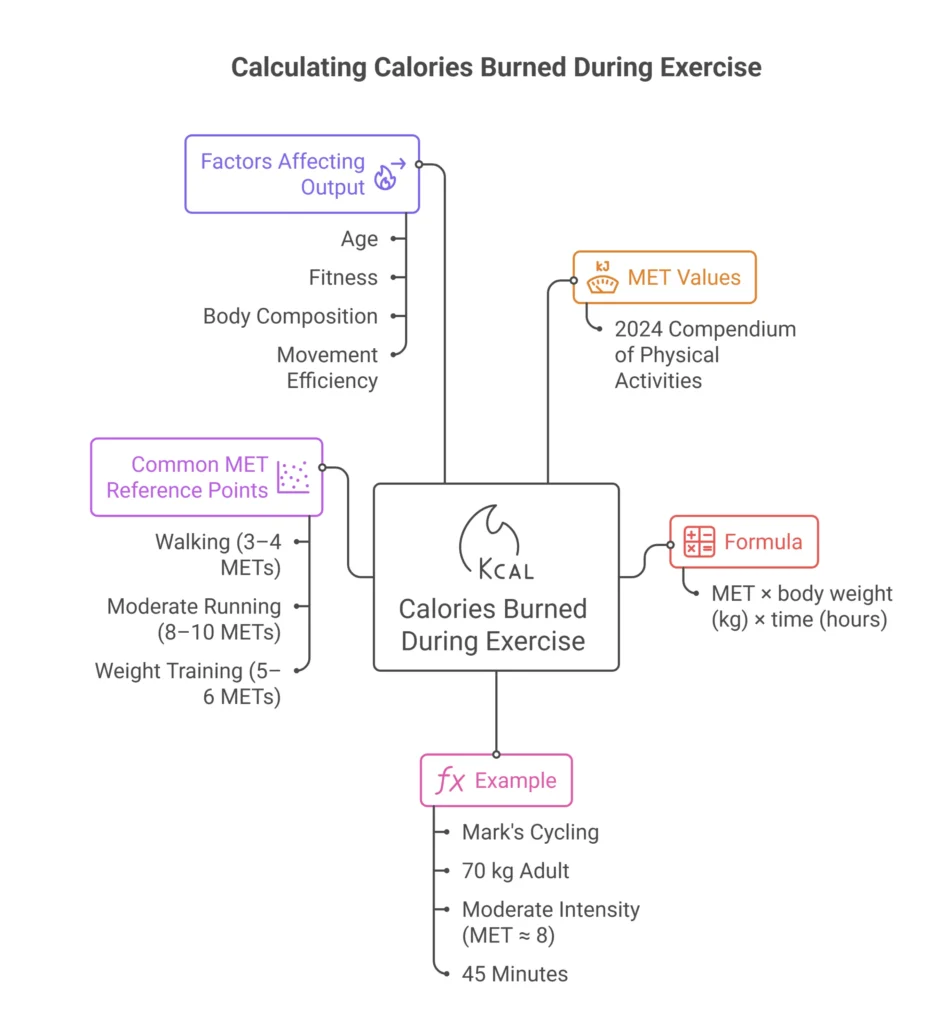
Calories burned during exercise can be estimated using body weight, activity intensity, and duration. A standard method uses MET values — Metabolic Equivalent of Task — which describe the energy cost of physical activities (2024 Compendium of Physical Activities).
The formula: Calories burned ≈ MET × body weight (kg) × time (hours)
Example — fictional 70 kg adult Mark, cycling at moderate intensity (MET ≈ 8) for 45 minutes:
8 × 70 × 0.75 = 420 calories (estimated)
Common MET reference points: walking is roughly 3–4 METs, moderate running 8–10 METs, weight training around 5–6 METs. The 2024 Compendium provides standardized MET values for hundreds of specific activities.
This is an estimate. Age, fitness, body composition, and movement efficiency all affect actual output.
How Many Calories Should I Burn a Day?
There is no universal exercise-calorie target.
Your body already burns energy at rest, during digestion, and through everyday movement. Exercise adds to that total — but it is rarely the largest share of daily expenditure.
What matters for weight management is your total energy balance over time, not a specific burn number per session. Use your estimated TDEE as the baseline. Build your deficit through intake — not by chasing a treadmill number. Exercise for health, fitness, and long-term consistency.
Are smartwatch calorie counts accurate? Treat them as rough comparisons rather than exact measurements. They are useful for tracking whether you moved more this week than last — not for calculating energy to the calorie.
5 Mistakes That Throw Off Your Calorie Estimate
Judging activity by workouts alone
Your job, daily steps, and sitting time matter as much as gym sessions.
Double-counting exercise
If your activity multiplier already includes regular training, adding estimated exercise calories on top counts that activity twice.
Treating the result as exact
A result of 2,317 calories looks precise. Your body does not burn exactly the same amount every day.
Ignoring serving sizes
Nutrition Facts values apply to the stated serving. Two servings means roughly twice the listed calories.
Never updating your estimate
Changes in weight, activity, or training can change your energy needs. Recalculate after any meaningful shift.
Frequently Asked Questions
Estimate your TDEE first. Choose an intake that creates a sustainable energy deficit. Monitor your weight trend over three to four weeks before adjusting — not day to day.
Look at your full week: job type, daily steps, sitting time, exercise frequency, and workout intensity. Someone who trains three days a week but sits eight hours a day often needs a lower activity setting than they expect.
No formula is perfectly accurate for everyone. A reliable calculator uses an established equation like Mifflin St Jeor, accounts for activity level, and clearly states its limitations. Use the result as a starting point — not a fixed prescription.
Not automatically. If your activity setting already reflects your normal training, adding exercise calories back may count that activity twice.
Your actual needs may differ from the estimate. Food intake is commonly undercounted. Activity may have shifted. Short-term water retention can also mask fat loss. Assess trends over three to four weeks before changing anything.
Your estimated TDEE is the starting point. If your body weight stays relatively stable for several weeks at a consistent average intake, that intake is close to your true maintenance.
After any meaningful change in body weight, activity level, training routine, or lifestyle. Your calorie needs are not fixed forever.
Your Calorie Target Is a Starting Point
You do not need a perfect number before you begin.
Start with a reasonable estimate. Watch how your body responds over several weeks. Adjust based on real results — not daily fluctuations.
Use our Calculator to estimate your daily energy expenditure, then use that number as your foundation for maintenance, weight loss, or weight gain planning.
Health and Safety Note
This content is for general education only and is not individualized medical or nutrition advice. The NIH Body Weight Planner similarly notes that general calorie planning tools are intended for healthy adults and are not appropriate as a substitute for professional medical guidance.
General calorie estimates may not be appropriate for people under 18, during pregnancy or breastfeeding, people with medical conditions affecting nutrition or metabolism, athletes with specialized fueling needs, or anyone with an eating disorder or history of disordered eating. Consult a qualified healthcare professional or registered dietitian when individual guidance is needed.
References
-
1
U.S. Food and Drug Administration. How to Understand and Use the Nutrition Facts Label.
-
2
Mifflin MD, St Jeor ST, Hill LA, Scott BJ, Daugherty SA, Koh YO. A New Predictive Equation for Resting Energy Expenditure in Healthy Individuals. American Journal of Clinical Nutrition. 1990;51(2):241–247.
-
3
Roza AM, Shizgal HM. The Harris Benedict Equation Reevaluated: Resting Energy Requirements and the Body Cell Mass. American Journal of Clinical Nutrition. 1984;40(1):168–182.
-
4
National Institute of Diabetes and Digestive and Kidney Diseases, NIH. Body Weight Planner.
-
5
U.S. Department of Agriculture and U.S. Department of Health and Human Services. Dietary Guidelines for Americans.
-
6
2024 Compendium of Physical Activities. Standardized MET Values for Physical Activity Energy Expenditure.